How to Measure Your Door Opening the Right Way
Thinking about replacing your front door or ordering a custom door? Before you browse styles, colours, or glass options, there is one thing you must do first — measure your door opening correctly. Getting this step right saves you time, money, and the frustration of a door that simply does not fit.
Why Accurate Measurements Matter
A custom door is manufactured to fit your specific opening. Unlike off-the-shelf doors, there is very little room for adjustment once it is built. Even a difference of half an inch can mean the door sits too tight, rattles in the frame, or simply cannot be installed without costly modifications.
The good news is that measuring your opening is straightforward — you only need a tape measure, a notepad, and about five minutes of your time. This guide will walk you through exactly what to measure and how.
What You Will Need
- A standard tape measure (at least 10 feet / 3 metres long)
- A notepad and pen — or your phone to take notes
- A helper is useful but not required
Understanding the Two Key Measurements
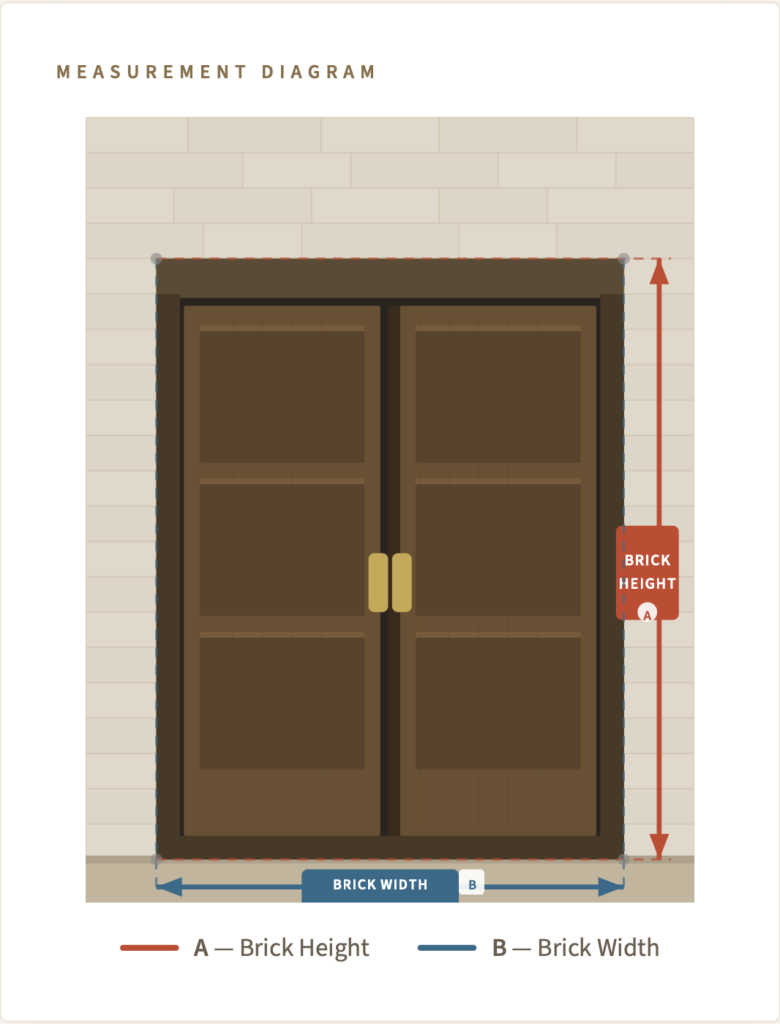
When you contact us for a quote, we ask for two specific measurements: Brick Height and Brick Width. These refer to the actual masonry opening in your wall — not the size of the existing door slab, not the frame, and not the rough opening. Here is what each one means.

| A BRICK HEIGHT | The vertical distance from the top of the brick opening down to finished floor level. This is measured on the inside face of the wall, from the underside of the lintel (the header brick or beam above your door) straight down to the floor or threshold. |
| B BRICK WIDTH | The horizontal distance across the brick opening, measured from the inner face of the left brick to the inner face of the right brick. Again, measure the opening in the masonry wall — not the width of the door or its frame. |
Step-by-Step: How to Take Your Measurements
Step 1 — Locate the Top of the Brick Opening
Stand facing your door from the outside. Look at the top of the opening — you will see either bare masonry brickwork, a concrete lintel, or a stone header sitting directly above where the door meets the wall. This is your starting point for the Brick Height measurement.
Tip: If your door has a decorative arch or curved top, always measure to the highest point of the arch at its centre.
Step 2 — Measure Straight Down (Brick Height)
Hook your tape measure at the very top edge of the brick opening. Let it drop straight down, keeping it as vertical as possible. Measure all the way down to the finished floor level — the surface of your porch, step, or threshold.
Record this number as your Brick Height. Write it down immediately.
Important: Do not measure from the top of the door slab or frame — always measure from the raw brick or masonry opening.
Step 3 — Measure Across the Opening (Brick Width)
Place the end of your tape measure against the inner face of the left brick — this is the flat masonry surface on the left side of your door opening. Stretch the tape horizontally across to the inner face of the right brick on the opposite side.
Record this number as your Brick Width.
Tip: Take this measurement at three heights — near the top, in the middle, and near the bottom of the opening. Old buildings can have slightly uneven openings. Use the smallest of the three readings.
Step 4 — Double-Check Everything
Professional installers always measure twice. Go back and repeat both measurements to make sure your numbers match. If they differ by more than 5mm (about ¼ inch), measure a third time and use the reading that appears twice.
Common Mistakes to Avoid
- Measuring the existing door slab: The door itself is smaller than the opening. Always measure the masonry opening — the gap in the wall.
- Measuring the frame instead of the brickwork: The door frame sits inside the brick opening. Measuring the frame will give you a number that is too small.
- Only measuring once: Walls are not always perfectly square. Taking measurements in multiple spots helps catch any irregularities.
- Rounding to the nearest inch: Supply your measurement to the nearest millimetre or ⅛ inch for accuracy. Rounding up or down can affect fit.
- Forgetting the floor level: If your threshold has a raised lip or step, measure from the finished floor surface, not from a higher point on the frame.
What Units Should I Use?
You can provide your measurements in either inches or millimetres — just make sure to be consistent and clearly state which unit you are using. For example: Brick Height 82½" and Brick Width 63¾" (inches), or Brick Height 2095mm and Brick Width 1620mm.
Ready to Get Your Quote?
Once you have both your Brick Height and Brick Width, you are ready to submit your enquiry. Head over to our online enquiry form, enter your measurements, and select your preferred door style and configuration. Our team will review your submission and get back to you with a detailed quote within 1–2 business days.
Still unsure? Download our free Measurement Guide PDF for a visual diagram and a checklist you can use on the day. Or simply get in touch and one of our door specialists will be happy to walk you through the process.
Quick Recap
- Brick Height = top of brick opening straight down to finished floor
- Brick Width = inner face of left brick across to inner face of right brick
- Measure in millimetres or inches — be consistent
- Always measure at least twice
- For uneven openings, use the smallest reading
- Never measure the door slab or the door frame — measure the brick opening
Questions? Contact our team — we are happy to help you get the right fit.